Looking for a replacement prop for my 90 HP Johnson, Model #j90TLCDC
I called west marine and the guy has no clue what he's doing or how to find it.
The number isn't on the prop..
If there are variances in pitch, can you recommend a prop pitch for a 28' pontoon? I just need to get from point A to point B.. no pulling..
Thanks!
help needed, looking for model number of prop for 90 HP John
Moderators: Redneck_Randy, badmoonrising, lakerunner
Re: help needed, looking for model number of prop for 90 HP John
New info..
Found a marina with one. He asked me my high RPM with current prop which is about 4000. He said I should have about 5,000 RPM full open one passenger.
The prop I had was a 13 pitch.. he's recommending an 11. He said a 13, since i have low RPM's compared to what they should be, is like going up hill in 3rd gear.
Any one know anything about this stuff?
Found a marina with one. He asked me my high RPM with current prop which is about 4000. He said I should have about 5,000 RPM full open one passenger.
The prop I had was a 13 pitch.. he's recommending an 11. He said a 13, since i have low RPM's compared to what they should be, is like going up hill in 3rd gear.
Any one know anything about this stuff?
Re: help needed, looking for model number of prop for 90 HP John
He is right.
The prop you end up with is determined by whats called WOT (Wide Open Throttle). So first you need to find out what WOT is supposed to be for your motor. Then out on the lake, see how high the RPM is at WOT.
For every 200 rpm you are short of reaching the engines WOT, lower the prop pitch by 1.
Sooo.. say the WOT for that engine is 5000 and your are getting 4600 max when hauling across the lake wide open, and your prop is a 13 pitch. Switching to a 11 pitch would give you 400 more rpm and allow you to reach WOT (5000).
While you can get in the ballpark by copying someone with a similar setup, each boat is different and you need to find out what works for You....
And thats the deal with That!

The prop you end up with is determined by whats called WOT (Wide Open Throttle). So first you need to find out what WOT is supposed to be for your motor. Then out on the lake, see how high the RPM is at WOT.
For every 200 rpm you are short of reaching the engines WOT, lower the prop pitch by 1.
Sooo.. say the WOT for that engine is 5000 and your are getting 4600 max when hauling across the lake wide open, and your prop is a 13 pitch. Switching to a 11 pitch would give you 400 more rpm and allow you to reach WOT (5000).
While you can get in the ballpark by copying someone with a similar setup, each boat is different and you need to find out what works for You....
And thats the deal with That!
--------------------


--------------------
'07 22 ft SunTracker Regency 135hp i/o
'02 Dodge 2500, Edge Juice w/Attitude
Colorado Springs, CO.
--------------------
'07 22 ft SunTracker Regency 135hp i/o
'02 Dodge 2500, Edge Juice w/Attitude
Colorado Springs, CO.
Re: help needed, looking for model number of prop for 90 HP John
HOW DOES A PROPELLER WORK?
A propeller converts the torque of the drive shaft into thrust -- that is, it changes "spin" into "go."
The prop works much like a wood screw. When you turn a screw out of wood. you can feel the screw pushing against you with every twist of your hand as the threads grip wood. In much the same way. propeller blades grip water, pushing against the boat and moving it forward. But since water is liquid. there's a great deal of slippage. And as the prop bites, the blades push water to the rear, creating what is called a thrust cone. It is actually this thrust cone, pushing against the undisturbed water around it. which propels the boat forward.
WHAT IS PITCH?
Prop design greatly affects the force of the thrust cone, and three propeller characteristics are especially important in this regard. One of these is pitch: the twist or angle of the prop blades measured against the direction of travel. Pitch is expressed in terms of distance traveled. A 15-inch pitch means that, theoretically, a prop would move 15 inches forward with each complete revolution. Slippage, turbulence. and other factors make the actual distance less, but the higher the pitch, the greater the forward travel.
At a given rate of revolution, the prop with higher pitch produces more speed.
WHAT IS PROP DIAMETER?
A propeller's diameter is the width of the circle described by the tips of the rotating blades. As with pitch. changing the prop diameter changes performance. The greater the diameter, thrust cone and blade area the more thrust a propeller will exert.
Water Testing for R.P.M.
There are three propeller variables: Diameter, pitch and numbers of blades. In the water test, the final "fine-tuning" adjustments can be made by changing the propeller to one with a different pitch. Reducing or increasing pitch can raise or lower RPM.
That's because a low-pitch propeller takes a smaller bite than a high-pitch propeller. In other words, low-pitch offers less resistance. With high-pitch. it's just the opposite -- there's more resistance.
Remember:
Lower-pitch = higher RPM
High-pitch = lower RPM.
Naturally, most trouble-shooting situations will invoke only Step Two, the water test. But it may be a good idea to include Step One as well, to be certain of the initial prop choice.
And remember that the right prop will work as it should only when everything else is right. As part of the regular trouble-shooting routine:
Check the transom height of your boat.
For outboard motors proper transom height is essential for maximum forward thrust from your propeller. If the transom is too high, the propeller will ventilate (take in too much air around the propeller) and may cause damage to your motor from excessive slippage. If the transom is too low, the motor will cause excessive drag, resulting in loss of speed and power and undesirable spray. To achieve the ideal transom length, it may be necessary to cut out or add to the transom. This step, or course, is unnecessary when selecting a stern drive propeller.
On a family-type boat the anti-cavitation plate of the outboard should run level to 1/2" below the boat bottom with the proper transom height. On large boats proper level is 1/2" to 1" below boat bottom. On light. fast boats the engine can be raised on the transom so that the anti-cavitation plate is level or above the bottom of the boat. Cupped propellers may be necessary if slippage of the propeller occurs.
Check the tilt angle of your boat.
Usually the best operating tilt angle is achieved when the drive-shaft of the motor is perpendicular to the surface of the water when the boat is at full throttle. It is impossible to determine this angle without putting the boat into the water and running with normal load and at rated full RPM. If the motor is tipped too close to the transom, the boat will dig or plow in a bow down position, with consequent performance loss. In addition, the boat will tend to swerve to the right and steer hard left. If the motor is tipped too far away from the transom, the boat will "gallop" or "porpoise" in a bow high position, and will swerve to the left and steer hard right. All outboard motors are equipped with tilt adjustment for achieving optimum angle. On stern drive boats without power trim, the outdrive angle will be preset by proper factory installation, it may be adjusted, if necessary, by adding or subtracting shims from under the front engine mounts, or a tilt pin on the outdrive (similar to an outboard).
Center the motor on the transom.
If the outboard motor is not centered exactly on the transom the unbalanced thrust will result in poor performance, hard steering, and possible gearcase damage.
Check the boat keel for interference.
A keel that is too deep or too wide will permit air bubbles to flow back to the propeller, causing not only slippage of the propeller, but also cavitation "burn" which will erode the propeller. To correct this condition it may be necessary to reshape the keel, tapering it to approximately 1/4" in height at the transom. beginning the taper about 30" forward from the transom. An improper keel will also cause slippage in turns.
Keep bottom of boat clean
A major cause of poor boat performance is a fouled bottom - an accumulation of marine growth, moss, and barnacles in sea water; and the accumulation of dirt, slime, lime, and other matter in fresh water. Cleaning the boat bottom will greatly improve boat performance. Anti-fouling paint will slow down the accumulation of these materials and organisms, but in salt water it may increase erosion of the gear case due to galvanic action. Different bottom paints also provide different performance differences. Some of the new Teflon paints for planing hulls can actually improve the performance of a particular hull. Some concern should be noted as to the application a well. Basically, the smoother the better.
Also note that some hull configurations have come to the market that are deigned almost exclusively for speed. These hulls usually have the tendency to be pigs, out of the hole. Most of these rigs are designed to be run exclusively with the new style stainless high performance propellers and won't even come on plain, without one.
And as the final note, it is important to spend the time and effort to get the prop correct for how you use the boat. Sometimes that may mean more than one prop for that boat and motor combination, depending on how, where, and when you use the boat. A lot of good propeller shops can help you tweak the prop to odd sizes to help accomplish that goal.
Engine and Boat Performance
Propeller Selection
Select a propeller that will allow the engine to operate at or near the top of the recommended full throttle RPM range with a normal load.
If the RPM is above the specified RPM, a propeller of the next higher pitch should be installed and tested.
If full throttle operation is below the specified RPM, a propeller of next lower pitch should be installed and tested.
For better acceleration, such as is needed in water skiing, propping to next lower pitch is recommended. However, do not operate continuously above the specified maximum RPM.
Common problems, which cause loss of RPM, may require a lower pitch propeller be installed.
a. Warmer weather and greater humidity.
b. Operating in a higher elevation.
c. Operating with dirty boat bottom.
d. Operating with an increased load (additional passengers,
pulling skiers, etc.).
Refer to your Operation and Maintenance Manual for propeller removal and installation.
Propeller Repair
If your propeller should become damaged, it can usually be repaired at one of the authorized propeller repair stations. Your authorized servicing dealer can advise location and procedure for shipping propeller to be repaired.
IMPORTANT: When a stainless steel propeller is installed on your product, it may increase the potential for galvanic corrosion action. If a stainless steel propeller is used, some type of corrosion protection should be provided, especially in salt or brackish water. See your authorized dealer for more details.
Conditions Affecting Operation
WEIGHT DISTRIBUTION
Positioning of weight (passengers and gear) inside the boat has the following effects:
Shifting weight to rear (stern).
*
Generally increases speed and engine RPM.
*
At extremes, can cause boat to porpoise. Causes bow to bounce in choppy water.
*
Increases danger of the following wave splashing into boat when coming off plane.
Shifting weight to front (bow).
*
Improves ease of planing off.
*
Improves rough water ride.
*
At extremes, can cause boat to Veer back and forth (bow to steer).
BOTTOM OF BOAT
To maintain maximum speed, the following conditions of the boat bottom should be observed:
*
Clean, free of barnacles and marine growth.
*
Free of distortion, nearly flat where it contacts the water.
*
Straight and smooth, fore and aft.
Engine and Boat Performance
Propeller Selection
Select a propeller that will allow the engine to operate at or near the top of the recommended full throttle RPM range with a normal load.
If the RPM is above the specified RPM, a propeller of the next higher pitch should be installed and tested.
If full throttle operation is below the specified RPM, a propeller of next lower pitch should be installed and tested.
For better acceleration, such as is needed in water skiing, propping to next lower pitch is recommended. However, do not operate continuously above the specified maximum RPM.
Common problems, which cause loss of RPM, may require a lower pitch propeller be installed.
a. Warmer weather and greater humidity.
b. Operating in a higher elevation.
c. Operating with dirty boat bottom.
d. Operating with an increased load (additional passengers,
pulling skiers, etc.).
Refer to your Operation and Maintenance Manual for propeller removal and installation.
Propeller Repair
If your propeller should become damaged, it can usually be repaired at one of the authorized propeller repair stations. Your authorized servicing dealer can advise location and procedure for shipping propeller to be repaired.
IMPORTANT: When a stainless steel propeller is installed on your product, it may increase the potential for galvanic corrosion action. If a stainless steel propeller is used, some type of corrosion protection should be provided, especially in salt or brackish water. See your authorized dealer for more details.
Conditions Affecting Operation
WEIGHT DISTRIBUTION
Positioning of weight (passengers and gear) inside the boat has the following effects:
Shifting weight to rear (stern).
*
Generally increases speed and engine RPM.
*
At extremes, can cause boat to porpoise. Causes bow to bounce in choppy water.
*
Increases danger of the following wave splashing into boat when coming off plane.
Shifting weight to front (bow).
*
Improves ease of planing off.
*
Improves rough water ride.
*
At extremes, can cause boat to Veer back and forth (bow to steer).
BOTTOM OF BOAT
To maintain maximum speed, the following conditions of the boat bottom should be observed:
*
Clean, free of barnacles and marine growth.
*
Free of distortion, nearly flat where it contacts the water.
*
Straight and smooth, fore and aft.
ANTI-FOULING PAINTS
In some areas, it may be advisable to paint bottom to help prevent marine growth. Anti-fouling paints with a tri-butyl-tin-adipate base can be applied safely to the boat bottom. See your dealer for recommendations for your boat.
IMPORTANT: Do not use anti-fouling paints which contain copper
or mercury compounds, as they will increase the
rate of corrosion.
IMPORTANT: Do not paint anodes or Cathode system's anode and
reference electrode, if so equipped, as this will
render them ineffective as galvanic corrosion
inhibitors. Leave a 1" taped, break line between
bottom paint and drive units, trim tabs, sensors, etc.
CAVITATION
Cavitation occurs when water flow cannot follow the contour of a fast moving underwater object, such as a gear housing or propeller cavitation permits the propeller to speed up but boat speed is reduced. Cavitation can seriously erode the surface of the gear housing or propeller. Common causes of cavitation are:
*
Bent propeller blade or damaged gear housing skeg.
*
Raised burrs or sharp edges on propeller or gear housing.
*
Weeds or other debris snagged on propeller or gear housing.
VENTILATION
Ventilation is caused by surface air or exhaust gases which are introduced around the propeller, resulting in propeller speed-up and reduction of boat speed. Excessive ventilation is annoying and usually caused by:
*
Stern drive trimmed out too far.
*
A missing propeller diffuser ring.
*
Damaged propeller or gear housing which allows exhaust gases to escape between propeller and gear housing.
How Elevation and Climate Affect Performance
Elevation has a very noticeable effect on the wide-open throttle power of an engine. Since air (containing oxygen) gets thinner as elevation
A propeller converts the torque of the drive shaft into thrust -- that is, it changes "spin" into "go."
The prop works much like a wood screw. When you turn a screw out of wood. you can feel the screw pushing against you with every twist of your hand as the threads grip wood. In much the same way. propeller blades grip water, pushing against the boat and moving it forward. But since water is liquid. there's a great deal of slippage. And as the prop bites, the blades push water to the rear, creating what is called a thrust cone. It is actually this thrust cone, pushing against the undisturbed water around it. which propels the boat forward.
WHAT IS PITCH?
Prop design greatly affects the force of the thrust cone, and three propeller characteristics are especially important in this regard. One of these is pitch: the twist or angle of the prop blades measured against the direction of travel. Pitch is expressed in terms of distance traveled. A 15-inch pitch means that, theoretically, a prop would move 15 inches forward with each complete revolution. Slippage, turbulence. and other factors make the actual distance less, but the higher the pitch, the greater the forward travel.
At a given rate of revolution, the prop with higher pitch produces more speed.
WHAT IS PROP DIAMETER?
A propeller's diameter is the width of the circle described by the tips of the rotating blades. As with pitch. changing the prop diameter changes performance. The greater the diameter, thrust cone and blade area the more thrust a propeller will exert.
Water Testing for R.P.M.
There are three propeller variables: Diameter, pitch and numbers of blades. In the water test, the final "fine-tuning" adjustments can be made by changing the propeller to one with a different pitch. Reducing or increasing pitch can raise or lower RPM.
That's because a low-pitch propeller takes a smaller bite than a high-pitch propeller. In other words, low-pitch offers less resistance. With high-pitch. it's just the opposite -- there's more resistance.
Remember:
Lower-pitch = higher RPM
High-pitch = lower RPM.
Naturally, most trouble-shooting situations will invoke only Step Two, the water test. But it may be a good idea to include Step One as well, to be certain of the initial prop choice.
And remember that the right prop will work as it should only when everything else is right. As part of the regular trouble-shooting routine:
Check the transom height of your boat.
For outboard motors proper transom height is essential for maximum forward thrust from your propeller. If the transom is too high, the propeller will ventilate (take in too much air around the propeller) and may cause damage to your motor from excessive slippage. If the transom is too low, the motor will cause excessive drag, resulting in loss of speed and power and undesirable spray. To achieve the ideal transom length, it may be necessary to cut out or add to the transom. This step, or course, is unnecessary when selecting a stern drive propeller.
On a family-type boat the anti-cavitation plate of the outboard should run level to 1/2" below the boat bottom with the proper transom height. On large boats proper level is 1/2" to 1" below boat bottom. On light. fast boats the engine can be raised on the transom so that the anti-cavitation plate is level or above the bottom of the boat. Cupped propellers may be necessary if slippage of the propeller occurs.
Check the tilt angle of your boat.
Usually the best operating tilt angle is achieved when the drive-shaft of the motor is perpendicular to the surface of the water when the boat is at full throttle. It is impossible to determine this angle without putting the boat into the water and running with normal load and at rated full RPM. If the motor is tipped too close to the transom, the boat will dig or plow in a bow down position, with consequent performance loss. In addition, the boat will tend to swerve to the right and steer hard left. If the motor is tipped too far away from the transom, the boat will "gallop" or "porpoise" in a bow high position, and will swerve to the left and steer hard right. All outboard motors are equipped with tilt adjustment for achieving optimum angle. On stern drive boats without power trim, the outdrive angle will be preset by proper factory installation, it may be adjusted, if necessary, by adding or subtracting shims from under the front engine mounts, or a tilt pin on the outdrive (similar to an outboard).
Center the motor on the transom.
If the outboard motor is not centered exactly on the transom the unbalanced thrust will result in poor performance, hard steering, and possible gearcase damage.
Check the boat keel for interference.
A keel that is too deep or too wide will permit air bubbles to flow back to the propeller, causing not only slippage of the propeller, but also cavitation "burn" which will erode the propeller. To correct this condition it may be necessary to reshape the keel, tapering it to approximately 1/4" in height at the transom. beginning the taper about 30" forward from the transom. An improper keel will also cause slippage in turns.
Keep bottom of boat clean
A major cause of poor boat performance is a fouled bottom - an accumulation of marine growth, moss, and barnacles in sea water; and the accumulation of dirt, slime, lime, and other matter in fresh water. Cleaning the boat bottom will greatly improve boat performance. Anti-fouling paint will slow down the accumulation of these materials and organisms, but in salt water it may increase erosion of the gear case due to galvanic action. Different bottom paints also provide different performance differences. Some of the new Teflon paints for planing hulls can actually improve the performance of a particular hull. Some concern should be noted as to the application a well. Basically, the smoother the better.
Also note that some hull configurations have come to the market that are deigned almost exclusively for speed. These hulls usually have the tendency to be pigs, out of the hole. Most of these rigs are designed to be run exclusively with the new style stainless high performance propellers and won't even come on plain, without one.
And as the final note, it is important to spend the time and effort to get the prop correct for how you use the boat. Sometimes that may mean more than one prop for that boat and motor combination, depending on how, where, and when you use the boat. A lot of good propeller shops can help you tweak the prop to odd sizes to help accomplish that goal.
Engine and Boat Performance
Propeller Selection
Select a propeller that will allow the engine to operate at or near the top of the recommended full throttle RPM range with a normal load.
If the RPM is above the specified RPM, a propeller of the next higher pitch should be installed and tested.
If full throttle operation is below the specified RPM, a propeller of next lower pitch should be installed and tested.
For better acceleration, such as is needed in water skiing, propping to next lower pitch is recommended. However, do not operate continuously above the specified maximum RPM.
Common problems, which cause loss of RPM, may require a lower pitch propeller be installed.
a. Warmer weather and greater humidity.
b. Operating in a higher elevation.
c. Operating with dirty boat bottom.
d. Operating with an increased load (additional passengers,
pulling skiers, etc.).
Refer to your Operation and Maintenance Manual for propeller removal and installation.
Propeller Repair
If your propeller should become damaged, it can usually be repaired at one of the authorized propeller repair stations. Your authorized servicing dealer can advise location and procedure for shipping propeller to be repaired.
IMPORTANT: When a stainless steel propeller is installed on your product, it may increase the potential for galvanic corrosion action. If a stainless steel propeller is used, some type of corrosion protection should be provided, especially in salt or brackish water. See your authorized dealer for more details.
Conditions Affecting Operation
WEIGHT DISTRIBUTION
Positioning of weight (passengers and gear) inside the boat has the following effects:
Shifting weight to rear (stern).
*
Generally increases speed and engine RPM.
*
At extremes, can cause boat to porpoise. Causes bow to bounce in choppy water.
*
Increases danger of the following wave splashing into boat when coming off plane.
Shifting weight to front (bow).
*
Improves ease of planing off.
*
Improves rough water ride.
*
At extremes, can cause boat to Veer back and forth (bow to steer).
BOTTOM OF BOAT
To maintain maximum speed, the following conditions of the boat bottom should be observed:
*
Clean, free of barnacles and marine growth.
*
Free of distortion, nearly flat where it contacts the water.
*
Straight and smooth, fore and aft.
Engine and Boat Performance
Propeller Selection
Select a propeller that will allow the engine to operate at or near the top of the recommended full throttle RPM range with a normal load.
If the RPM is above the specified RPM, a propeller of the next higher pitch should be installed and tested.
If full throttle operation is below the specified RPM, a propeller of next lower pitch should be installed and tested.
For better acceleration, such as is needed in water skiing, propping to next lower pitch is recommended. However, do not operate continuously above the specified maximum RPM.
Common problems, which cause loss of RPM, may require a lower pitch propeller be installed.
a. Warmer weather and greater humidity.
b. Operating in a higher elevation.
c. Operating with dirty boat bottom.
d. Operating with an increased load (additional passengers,
pulling skiers, etc.).
Refer to your Operation and Maintenance Manual for propeller removal and installation.
Propeller Repair
If your propeller should become damaged, it can usually be repaired at one of the authorized propeller repair stations. Your authorized servicing dealer can advise location and procedure for shipping propeller to be repaired.
IMPORTANT: When a stainless steel propeller is installed on your product, it may increase the potential for galvanic corrosion action. If a stainless steel propeller is used, some type of corrosion protection should be provided, especially in salt or brackish water. See your authorized dealer for more details.
Conditions Affecting Operation
WEIGHT DISTRIBUTION
Positioning of weight (passengers and gear) inside the boat has the following effects:
Shifting weight to rear (stern).
*
Generally increases speed and engine RPM.
*
At extremes, can cause boat to porpoise. Causes bow to bounce in choppy water.
*
Increases danger of the following wave splashing into boat when coming off plane.
Shifting weight to front (bow).
*
Improves ease of planing off.
*
Improves rough water ride.
*
At extremes, can cause boat to Veer back and forth (bow to steer).
BOTTOM OF BOAT
To maintain maximum speed, the following conditions of the boat bottom should be observed:
*
Clean, free of barnacles and marine growth.
*
Free of distortion, nearly flat where it contacts the water.
*
Straight and smooth, fore and aft.
ANTI-FOULING PAINTS
In some areas, it may be advisable to paint bottom to help prevent marine growth. Anti-fouling paints with a tri-butyl-tin-adipate base can be applied safely to the boat bottom. See your dealer for recommendations for your boat.
IMPORTANT: Do not use anti-fouling paints which contain copper
or mercury compounds, as they will increase the
rate of corrosion.
IMPORTANT: Do not paint anodes or Cathode system's anode and
reference electrode, if so equipped, as this will
render them ineffective as galvanic corrosion
inhibitors. Leave a 1" taped, break line between
bottom paint and drive units, trim tabs, sensors, etc.
CAVITATION
Cavitation occurs when water flow cannot follow the contour of a fast moving underwater object, such as a gear housing or propeller cavitation permits the propeller to speed up but boat speed is reduced. Cavitation can seriously erode the surface of the gear housing or propeller. Common causes of cavitation are:
*
Bent propeller blade or damaged gear housing skeg.
*
Raised burrs or sharp edges on propeller or gear housing.
*
Weeds or other debris snagged on propeller or gear housing.
VENTILATION
Ventilation is caused by surface air or exhaust gases which are introduced around the propeller, resulting in propeller speed-up and reduction of boat speed. Excessive ventilation is annoying and usually caused by:
*
Stern drive trimmed out too far.
*
A missing propeller diffuser ring.
*
Damaged propeller or gear housing which allows exhaust gases to escape between propeller and gear housing.
How Elevation and Climate Affect Performance
Elevation has a very noticeable effect on the wide-open throttle power of an engine. Since air (containing oxygen) gets thinner as elevation
Respect Our Recreational Resources
Leaving Only "The Footprints of Your Passing"
Boating the Muskingum River
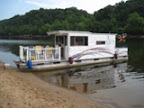
1972 35' Crest Pontoon Houseboat
2007 90 hp. Yamaha
Leaving Only "The Footprints of Your Passing"
Boating the Muskingum River
1972 35' Crest Pontoon Houseboat
2007 90 hp. Yamaha
Re: help needed, looking for model number of prop for 90 HP John
Turns out the prop was wrong. The splines at the top lined up but the shaft at the bottom was slightly wider than the new prop allowed.. so it didn't seat all the way.
Is there an easy way to track down the correct prop?
Is there an easy way to track down the correct prop?