
Is this prop slip? From 3800 to 5600 rpm's same speed on gps?
Now that I think about it I get the same top speed from just under 4000 rpm or 5600 rpm. The toon is 6 yrs old but only had 58 hours on the engine and I believe original prop from 2004. Can the wear out over age and get a ton more slip? Is it better to go ss or at speeds under 40 does it not matter? Ss in my baja I just got rid of with a 454 magnum made a huge difference. Thanks
Tom
Is this prop slip ?
Moderators: Redneck_Randy, badmoonrising, lakerunner
Is this prop slip ?
2004 Crest XRS III 25
140hp Johnson 4 stroke
Underskinned 13.5X15 BRP al prop
29.1 mph @ 5800rpm
Lk St Clair, MI
140hp Johnson 4 stroke
Underskinned 13.5X15 BRP al prop
29.1 mph @ 5800rpm
Lk St Clair, MI
-
dockholiday
- Posts: 2916
- Joined: Thu Nov 06, 2008 7:32 pm
- Location: Lake Oconee, Ga.
Re: Is this prop slip ?
If you are getting correct tach readings, something is going on.
Here is a little info an calculator.
http://propulse.jetshop.se/default.aspx (click on prop university at the top....link doesn't take you to article)
http://www.mercuryracing.com/propellers ... ulator.php
Here is a little info an calculator.
http://propulse.jetshop.se/default.aspx (click on prop university at the top....link doesn't take you to article)
http://www.mercuryracing.com/propellers ... ulator.php
Dying ain't much of living boy
http://www.youtube.com/watch?feature=pl ... gm-sp1-Nhs
http://www.youtube.com/watch?feature=pl ... gm-sp1-Nhs
-
scfishnman
- Posts: 267
- Joined: Fri Mar 17, 2006 9:30 am
- Location: Lake Murray near Chapin, SC
Re: Is this prop slip ?
My first pontoon boat had a faulty tachometer. It would give false readings such as you are describing. Might be worth investigating before spending big bucks on a new prop.
-- Aqua Patio 240DC triple toon 225 Yamaha 4-stroke
-- 17' Polar Kraft w/ 75 hp Evinrude Etec
-- Yamaha Waverunner FX Cruiser HO
-- Yamaha Waverunner FX HO
-- 17' Polar Kraft w/ 75 hp Evinrude Etec
-- Yamaha Waverunner FX Cruiser HO
-- Yamaha Waverunner FX HO
Re: Is this prop slip ?
Using that calculator what would be acceptable prop slip? If the slip is too high, how is that fixable, new prop? Thanks
Scott
2006 22' Crest II Le
90 HP Suzuki 4 Stroke
2005 Seadoo GTX Limited
2006 Seadoo GTX SC
Central Illinois
2006 22' Crest II Le
90 HP Suzuki 4 Stroke
2005 Seadoo GTX Limited
2006 Seadoo GTX SC
Central Illinois
Re: Is this prop slip ?
Some sources of Prop issues:
Ventilation
Ventilation occurs when air from the water's surface or exhaust gases from the exhaust outlet are drawn into the propeller blades. The normal water load is reduced and the propeller over-revs, losing much of its thrust; however, as the propeller momentarily over-revs, this brings on massive cavitation (see Cavitation, following), which can further "unload" the propeller and stop all forward thrust. It continues until the propeller is slowed down enough to allow the bubbles to surface, and the original cause of cavitation is eliminated. This action most often occurs in turns, particularly when trying to plane in a sharp turn or with an excessively trimmed-out engine or drive unit.Outboard engines and stern drive units are designed with a large "antiventilation" plate cast integrally into the gear housing (also commonly called the "gearcase") directly above the propeller. This plate is frequently, but incorrectly, referred to as a "cavitation" or "anticavitation" plate. The purpose of this plate is to eliminate or reduce the possibility of air being drawn from the surface into the negative pressure side of the propeller blades. For improved engine and boat performance, most Mercury propellers feature a hub design with a flared trailing edge or "diffuser ring." This assists exhaust gas flow and provides a high-pressure barrier that helps prevent exhaust gases from feeding back into the negative pressure side of the blades, which is another form of ventilation.
Cavitation
We all know that water boils at 212°F (100°C) at normal sea-level atmospheric pressure. But water also boils at room temperature if the atmospheric pressure is low enough. As a shape passes through water at an increasing speed, the pressure that holds the water to the sides and back of the shape is lowered. Depending upon the water temperature, when the pressure reaches a sufficiently low level, boiling (i.e., the formation of water vapor) will begin. This occurs most often on a propeller near the leading edge of the blade. When speed is reduced and the pressure goes up, boiling will subside. As the water vapor bubbles move downstream into a high- pressure region that won't sustain boiling, they collapse (condense back to liquid). The collapsing action, or implosion, of the bubbles releases energy that chips away at the blades, causing a "cavitation burn" or erosion of the metal.
The initial cause of the low pressure may be nicks in the leading edge, too much cup, sharp leading edge comers, improper polishing, or, sometimes, poor blade design. Massive cavitation by itself is rare, and it usually is caused by a propeller that is severely bent or has had its blade tips broken off resulting in a propeller that is far too small in diameter for the engine. (See Ventilation, above, for another common cause.)
In this instance, a sharp leading edge produces cavitation and resulting cavitation burn as the bubbles condense further back on the blade face. Such cavitation burn can usually be corrected by repairing or rounding off the leading edge directly in front of the burn. Cavitation and cavitation burns can also form on the side of your gearcase. This will almost always be the result of a sharp edge directly ahead of the burn. Rounding off the sharp edge will usually eliminate the problem.
Slip
Slip is the most misunderstood of all propeller terms, probably because it sounds like something undesirable. Slip is not a measure of propeller efficiency. Rather, slip is the difference between actual and theoretical travel resulting from a necessary propeller blade angle of attack. For example, a 10" propeller actually advances only 8-1/2" in one revolution. Eight and one-half inches is 85% of 10", leaving a slip of 15%. If the blade had no angle of attack, there would be no slip; but, of course, there would be no positive and negative pressure created on the blades and, therefore, there would be no thrust.
To create thrust there must be some angle of attack or slip. The objective of propeller design is to achieve the right amount of slip or angle of attack, which is around 40, give or take a degree. This is accomplished by matching the right amount of blade diameter and blade area to the existing engine horsepower and propeller shaft RPM. Too much diameter and/or blade area will lower slip but will also lower propeller efficiency, resulting in reduced performance.
I'm hoping this will help answer some of the mystery surrounding props.
Ventilation
Ventilation occurs when air from the water's surface or exhaust gases from the exhaust outlet are drawn into the propeller blades. The normal water load is reduced and the propeller over-revs, losing much of its thrust; however, as the propeller momentarily over-revs, this brings on massive cavitation (see Cavitation, following), which can further "unload" the propeller and stop all forward thrust. It continues until the propeller is slowed down enough to allow the bubbles to surface, and the original cause of cavitation is eliminated. This action most often occurs in turns, particularly when trying to plane in a sharp turn or with an excessively trimmed-out engine or drive unit.Outboard engines and stern drive units are designed with a large "antiventilation" plate cast integrally into the gear housing (also commonly called the "gearcase") directly above the propeller. This plate is frequently, but incorrectly, referred to as a "cavitation" or "anticavitation" plate. The purpose of this plate is to eliminate or reduce the possibility of air being drawn from the surface into the negative pressure side of the propeller blades. For improved engine and boat performance, most Mercury propellers feature a hub design with a flared trailing edge or "diffuser ring." This assists exhaust gas flow and provides a high-pressure barrier that helps prevent exhaust gases from feeding back into the negative pressure side of the blades, which is another form of ventilation.
Cavitation
We all know that water boils at 212°F (100°C) at normal sea-level atmospheric pressure. But water also boils at room temperature if the atmospheric pressure is low enough. As a shape passes through water at an increasing speed, the pressure that holds the water to the sides and back of the shape is lowered. Depending upon the water temperature, when the pressure reaches a sufficiently low level, boiling (i.e., the formation of water vapor) will begin. This occurs most often on a propeller near the leading edge of the blade. When speed is reduced and the pressure goes up, boiling will subside. As the water vapor bubbles move downstream into a high- pressure region that won't sustain boiling, they collapse (condense back to liquid). The collapsing action, or implosion, of the bubbles releases energy that chips away at the blades, causing a "cavitation burn" or erosion of the metal.
The initial cause of the low pressure may be nicks in the leading edge, too much cup, sharp leading edge comers, improper polishing, or, sometimes, poor blade design. Massive cavitation by itself is rare, and it usually is caused by a propeller that is severely bent or has had its blade tips broken off resulting in a propeller that is far too small in diameter for the engine. (See Ventilation, above, for another common cause.)
In this instance, a sharp leading edge produces cavitation and resulting cavitation burn as the bubbles condense further back on the blade face. Such cavitation burn can usually be corrected by repairing or rounding off the leading edge directly in front of the burn. Cavitation and cavitation burns can also form on the side of your gearcase. This will almost always be the result of a sharp edge directly ahead of the burn. Rounding off the sharp edge will usually eliminate the problem.
Slip
Slip is the most misunderstood of all propeller terms, probably because it sounds like something undesirable. Slip is not a measure of propeller efficiency. Rather, slip is the difference between actual and theoretical travel resulting from a necessary propeller blade angle of attack. For example, a 10" propeller actually advances only 8-1/2" in one revolution. Eight and one-half inches is 85% of 10", leaving a slip of 15%. If the blade had no angle of attack, there would be no slip; but, of course, there would be no positive and negative pressure created on the blades and, therefore, there would be no thrust.
To create thrust there must be some angle of attack or slip. The objective of propeller design is to achieve the right amount of slip or angle of attack, which is around 40, give or take a degree. This is accomplished by matching the right amount of blade diameter and blade area to the existing engine horsepower and propeller shaft RPM. Too much diameter and/or blade area will lower slip but will also lower propeller efficiency, resulting in reduced performance.
I'm hoping this will help answer some of the mystery surrounding props.
Respect Our Recreational Resources
Leaving Only "The Footprints of Your Passing"
Boating the Muskingum River
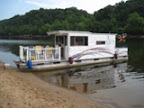
1972 35' Crest Pontoon Houseboat
2007 90 hp. Yamaha
Leaving Only "The Footprints of Your Passing"
Boating the Muskingum River
1972 35' Crest Pontoon Houseboat
2007 90 hp. Yamaha